
History of Asinara:
From the Neolithic to the National Park

Few places in Italy contain such a dense historical stratification in just 52 square kilometers: Neolithic tombs, legends linked to Hercules, a Camaldolese monastery, thousands of Austro-Hungarian prisoners from the First World War, and, for over a century, one of Italy's harshest penitentiary systems. Asinara is not merely an island of unspoiled nature—it is an open-air historical document.
Anyone who visits the National Park today without knowing this history risks seeing mere abandoned buildings where, in fact, are the places where Giovanni Falcone and Paolo Borsellino prepared the trials against the Mafia, or the structures where some of the most notorious figures of Italian terrorism were detained. This guide reconstructs the main phases of the island's history, from the earliest prehistoric evidence to the establishment of the National Park in 1997, offering visitors a comprehensive key to understanding what they will encounter during their visit.

The Origins: From the Domus de Janas to the Myth of Hercules
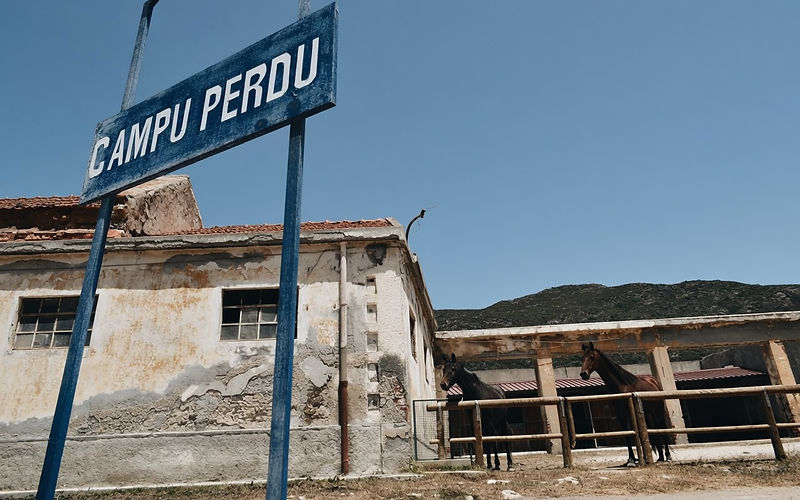
The earliest evidence of human presence on Asinara dates back to the Neolithic era and is represented by the domus de janas, rock-cut hypogean tombs located in the Campu Perdu area. These funerary structures, common in various parts of Sardinia, indicate a stable human presence on the island as far back as thousands of years ago.
Some Greco-Roman texts link the island to the myth of Hercules, who, according to tradition, reached it during his travels in Sardinia. This anecdote is the origin of one of the island's oldest names, Herculis insula (Island of Hercules).
Asinara's position—in the center of the western Mediterranean—made it for centuries a commercial outpost and a strategic defensive point. The Romans, who frequented it actively, gave it the name Sinuaria, referring to its jagged, sinuous shape. Later, the island became a landing point for Byzantines and Arab populations, and in the Middle Ages, it was the stage for clashes between the maritime republics vying for control of Sardinia.
The Monastic Period and the First Stable Community
From around 1100 and for several decades, Asinara was inhabited by a group of Camaldolese monks, a Benedictine order that founded the monastery of Sant'Andrea (St. Andrew). Of the ancient structure, which gave its name to the area where it stood, few tangible traces remain today—but the toponym Sant'Andrea still identifies that area of the island.
After decades marked by raids by corsairs and pirates, and several failed colonization attempts, the island finally saw the formation of its first stable community: shepherds of Sardinian origin and a few families of fishermen from Liguria and other Italian regions.
Despite the difficulties linked to scarce resources and the distance from Sardinia, this community experienced a period of relative tranquility that lasted until the early modern era—a balance that would be abruptly interrupted by the decisions of the new Italian government.

1885: The Expropriation and the Birth of the Penal Colony
The year 1885 marks the definitive watershed in the island's history. After a long intellectual and political debate, the Chamber of Deputies approved the proposal to establish a lazaretto (quarantine station) and an agricultural penal colony on Asinara.
To carry out this project, the resident population was forcibly removed, forced to abandon their homes and lands. The families scattered across various areas of northern Sardinia; some settled in the area where Stintino now stands, founding the eponymous village—a detail that inextricably links the history of Asinara to that of the town that today represents one of the main departure points for visiting the island.
From this moment on, the island was administered entirely by two distinct entities: the penal colony and the health station.
The penal colony was based on the forced labor of inmates and was organized into about ten branches, built at different times and distributed across the entire territory. The prison population was divided according to the severity of their crimes and their skills: each structure was dedicated to specific productive activities—livestock farming, cereal cultivation, viticulture—exploiting the characteristics of the surrounding territory. During the stabilization phase, inmates serving the end of their sentences or convicted of minor offenses were granted specialized activities such as shoemaking, barbering, or mechanics.
The Maritime Quarantine Health Station, on the other hand, housed the crews of ships transiting the Mediterranean who were suspected of having contracted epidemics such as cholera and tuberculosis. It was organized in buildings called "Periods," where patients went through the various stages of remission from the disease. It remained active until the post-World War II period, when advances in medicine and the general improvement in living conditions made this function obsolete.

The Twentieth Century: Prisoner-of-War Camp and International Tragedies
In the early twentieth century, Asinara also took on the role of a prisoner-of-war camp, becoming the stage for some of the most dramatic episodes in its history.
Starting in 1915, the Italian state transferred thousands of Austro-Hungarian prisoners there, captured during the First World War and previously held in Serbia. When Serbia was invaded, these prisoners were caught up in the dramatic retreat of the Serbian people toward their Italian ally—a tortuous route remembered in historiography as "the march of death," which caused numerous casualties. Having finally arrived on Asinara, already weakened by disease and hardship, many of them died on the island despite the efforts of the medical staff and the Italian army. They are buried in the Ossuary of Campu Perdu, built in 1936.
In the 1930s, during the Italian colonial campaign in North Africa, the camp also housed a group of Ethiopian prisoners, some of noble rank. Among them was Princess Romanework Hailé Selassié (1913 – Turin, 14 October 1940), eldest daughter of Emperor Hailé Selassié. One of her sons fell seriously ill with tuberculosis and died on the island; the princess was later transferred to Turin, to the convent of the Consolata missionaries, where she remained until her death.
In 1943, to the north of the island, in the sea beyond Punta Scorno, another internationally significant event occurred: the sinking of the Roma, a famous Italian warship, struck by German bombers.

From the Post-War Period to the Super-Prison
At the end of the Second World War, with the closure of the Health Station, the penal colony gained full control of the territory. In the 1970s, the penitentiary institution underwent a radical transformation: security was reinforced, and some branches were restructured to become the site of the super-prison (maximum-security prison).
This transformation caused great discontent among the inhabitants of Porto Torres, who saw the island become even more inaccessible and fortified. In the following decades, Asinara housed some of Italy's most notorious detainees: members of Cosa Nostra, the Camorra, and organized terrorism, including the Red Brigades, as well as figures from Sardinian banditry.
The extreme security measures made the island suitable even for top-level investigative purposes. In 1985, judges Giovanni Falcone and Paolo Borsellino stayed for about a month, along with their families, at the former Foresteria (guesthouse) of Cala d'Oliva—now the site of a barracks of the Sardinia Region Forestry Corps—to prepare certain documents relating to the Mafia trials.

From the Prison Closure to the National Park
The closure of the Asinara prison was a gradual process, also the result of intense protests from the local community. Already from the 1960s, the population of Stintino and the surrounding areas glimpsed the potential of converting the territory into a protected area—without forgetting the ancient expropriation of 1885.
In 1997, this path reached its conclusion with the establishment of the Asinara National Park. A few years later, the Marine Protected Area was also established, now managed together with the terrestrial park by a single body: the National Park and Marine Protected Area Authority "Island of Asinara."
The history of Asinara is a journey spanning over five millennia, passing from a Neolithic settlement to mythological legend, from a commercial outpost to a place of forced exile, from an international prisoner-of-war camp to a maximum-security super-prison, all the way to its transformation into a protected area. Every phase has left visible traces—from the domus de janas to the Ossuary of Campu Perdu, from the prison branches to the former Foresteria of Cala d'Oliva.
Understanding this historical stratification allows one to read the island's landscape in a completely different way: what today appears as wild nature and silence is the direct result of over a century of forced isolation. It is likely that Asinara's historical value will continue to grow as a complementary attraction to its extraordinary biodiversity, offering visitors an experience that combines historical memory and environmental conservation.

If you liked this article and you feel like going on an excursion to the Asinara National Park, contact us: we organize guided tours and excursions to Asinara with the lowest prices in Stintino for this summer 2025
How much it costs to visit Asinara?
With us the landing fee at the Asinara National Park is included in the price and if you choose the half-day excursion you will have a free tasting of Sardinian products.

VISITA GUIDATA ALL'ASINARA IN CATAMARANO
Giornata Intera
09:30 - 17:30
1 May – 30 June
Private Catamaran Charter: €1,200
Per person: €100 (€90 kids)
July
Private Catamaran Charter: €1,500
Per person: €125 (€115 kids)
August
Private Catamaran Charter: €1,620
Per person: €135 (€125 kids)
September
Private Catamaran Charter: €1500
Per person: €125 (€115 kids)
October
Private Catamaran Charter: €1,200
Per person: €100 (€90 kids)

GITA ALL'ASINARA
DI MEZZA
GIORNATA
Mezza Giornata
09:30 - 13:30
14:00 - 18:00
1 May – 30 June
Private Maxi RIB Charter: €780
Per person: €65 (€60 kids)
July – August
Private Maxi RIB Charter: €900
Per person: €75 (€70 kids)
1 September – 30 October
Private Maxi RIB Charter: €780
Per person: €65 (€60 kids)
Frequently Asked Questions
What are the oldest traces of human presence on Asinara?
The oldest traces date back to the Neolithic era and are represented by the domus de janas, rock-cut tombs located in the Campu Perdu area, which indicate a stable human presence on the island as far back as thousands of years ago.
How is Asinara connected to Stintino?
When the penal colony was established in 1885, the resident population was forcibly removed from the island. Some families settled in the area where Stintino now stands, founding the eponymous village on the Sardinian coast facing Asinara.
What did Falcone and Borsellino go to Asinara to do?
In 1985, judges Giovanni Falcone and Paolo Borsellino stayed for about a month at the former Foresteria of Cala d'Oliva, together with their families, to prepare certain documents relating to the Mafia trials, benefiting from the extreme security measures guaranteed by the island.
What is the Ossuary of Campu Perdu?
It is a monument built in 1936 where the Austro-Hungarian prisoners of the First World War are buried. They died on Asinara after being caught up in the "march of death" across Serbia during the retreat toward their Italian ally.
When was the Asinara National Park established?
The Asinara National Park was established in 1997, after decades of protests by the local community who, since the 1960s, had envisioned its conversion into a protected area. The Marine Protected Area was founded a few years later.
What happened to the battleship Roma near Asinara?
In 1943, the battleship Roma, a famous Italian warship, sank in the sea north of the island, beyond Punta Scorno, struck by German bombers during the Second World War.
Who was Princess Romanework Hailé Selassié and what does she have to do with Asinara?
She was the eldest daughter of Ethiopian Emperor Hailé Selassié, detained on Asinara in the 1930s as a prisoner during the Italian colonial campaign in North Africa. One of her sons died on the island of tuberculosis.

