
Marine Flora and Fauna of Asinara

Fifteen square kilometers of Posidonia oceanica meadow, waters that reach 26°C in August, and populations of brown grouper larger and more numerous than in many other areas of the Mediterranean: the seabeds of Asinara National Park represent one of Italy's best-preserved marine ecosystems. Those who approach these waters only for their turquoise color risk missing what truly makes them extraordinary: one of the most extensive Posidonia meadows in the Mediterranean basin, populations of threatened species such as the giant limpet in exceptional condition, and the regular presence of cetaceans that led to the inclusion of these waters in the Cetacean Sanctuary. This guide describes the marine habitats of Asinara, the species most relevant from a scientific and conservation standpoint, and the oceanographic characteristics that make this stretch of sea a benchmark for research in the Mediterranean. By the end, you will have a clear picture of what makes these seabeds unique and why their protection carries international significance.

Posidonia Meadows: Asinara's Key Habitat
Posidonia oceanica is defined as a marine plant endemic to the Mediterranean, characterized by long ribbon-like leaves gathered in bundles. Young leaves display a light green coloration, while older ones turn dark green and brown. The deeply intertwined rhizomes form structures called "matte," which, through the action of currents, can develop channels and distinctive formations. Unlike a simple expanse of algae, Posidonia meadows perform a structural function for the entire coastal ecosystem: they stabilize loose seabeds and reduce wave action, both through their leaf structure and through the barrier effect of the matte. For this reason, the consistency and structure of Posidonia beds are considered indicators of coastal system quality, particularly sensitive to pollution, erosion, increased turbidity, and mechanical impact from fishing and anchoring. The distribution around Asinara follows the morphological contrast between the island's two sides:
-
On the eastern side, between Rada dei Fornelli and Punta Sabina, the meadow extends to a depth of about 35 meters over an area of approximately 15 km², making it one of the most important Posidonia beds in the Mediterranean
-
On the western side, its presence is more localized, between Punta Tumbarino and Porto Manno della Reale, down to a maximum depth of 30-40 meters Overall, the meadow is in excellent condition, as confirmed by the periodic presence of flowers and fruit and high leaf density values. There are, however, limited areas showing signs of regression, caused mainly by excessive anchoring and, in some areas, traces of trawling.
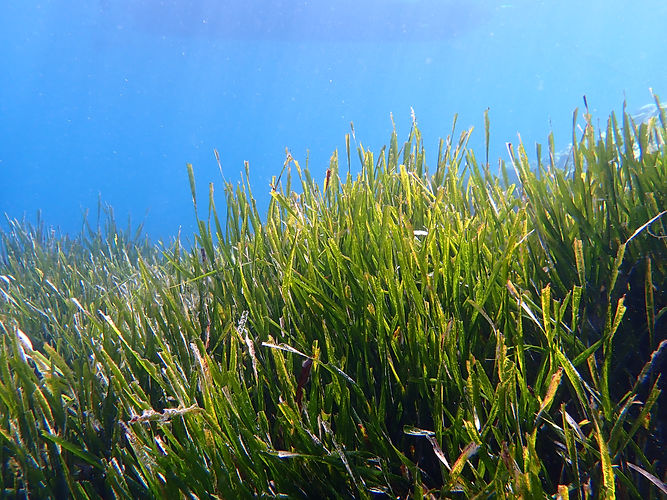
Flagship Seabed Species: Pinna nobilis, Patella ferruginea and Lithophyllum lichenoides
Within and along the edges of the Posidonia meadows live several species of conservation importance that extend well beyond the boundaries of Asinara. The bivalve Pinna nobilis is a species of Community interest, subject to specific studies by the Park Authority. At the level of the Posidonia rhizomes, communities typical of deeper environments are also found, with sea cucumbers and starfish frequently observed. Near the lower edge of the meadow, communities resembling pre-coralligenous formations develop instead. Two species deserve particular attention for their conservation status:
-
Lithophyllum lichenoides, a red algae included on the red list of species to be protected, undergoing strong decline in many areas of the Mediterranean due to its high sensitivity to pollution
-
Patella ferruginea, severely threatened elsewhere mainly due to excessive human harvesting. At Asinara, by contrast, populations are in good condition, often with individuals of notable size, up to 10 cm in width At depths exceeding 70 meters, in the area of Punta dello Scorno, a population of Laminaria rodriguezii has also been recorded—a rare Mediterranean paleo-endemic that also holds economic importance as a habitat for numerous commercial species.

Fish Fauna of the Rocky Seabeds:
Over 70 Cataloged Species
The rocky seabeds of Asinara host a rich and diverse fish community, documented in a catalog comprising dozens of families, from the Labridae (with as many as 12 species of wrasse) to the Sparidae (with dentex, gilthead bream, sea bream and salema). Some species hold particular importance due to their commercial or conservation value:
-
The spiny lobster (Palinurus elephas) is found in its adult phase between 15 and 100 meters of depth, in rocky crevices; juvenile specimens can also be observed at shallower depths, within the Posidonia meadows
-
The brown grouper displays specimens of notable size along the northern coast, observable at shallower depths than is typically the case in unprotected areas—a direct indicator of the effectiveness of protection
-
The slipper lobster or Mediterranean locust lobster (Scyllarides latus) is included on the list of species to be protected, heavily threatened by indiscriminate harvesting elsewhere This produces a significant cumulative effect: the combination of abundant and relatively undisturbed populations of species such as moray eels, conger eels and octopuses, together with the richness of benthic communities, makes the seabeds of Asinara not only a scientific asset but also a genuine resource for sustainable diving tourism.

Cetaceans and the Mediterranean Cetacean Sanctuary
The waters of Asinara are not frequented solely by benthic and coastal fish species. The regular presence of bottlenose dolphins and other cetaceans—including fin whales and sperm whales—led to the inclusion of these waters within the Cetacean Sanctuary, an international project for the conservation of Mediterranean pelagic fauna. This element sets Asinara apart from many other marine protected areas of similar size: the presence of large cetaceans requires an extent and quality of habitat that go well beyond a single coastal area, linking Asinara to a broader conservation network spanning several countries of the western Mediterranean.

Sea Movements: Currents, Winds and Navigability
Surface circulation along Asinara's western side shows marked seasonality. In winter, currents move from northeast to southwest, carrying water masses from the western coast of Corsica; in summer, the flow reverses. Within the Gulf of Asinara, currents instead tend to follow a clockwise circulation, more pronounced in the presence of westerly winds, and to run parallel to the coastline in the nearshore strip. With southwesterly (libeccio) winds, nearshore currents take on a significant offshore component, generating a vertical movement of the gulf's deeper waters. Data collected by the Italian Air Force over 32 years of observations at Punta Scorno provide a general, though not recent, picture of sea conditions: the sea is nearly calm on 20% of days, slightly rough on one day in two, and very rough in 25% of cases. The period between May and September offers more favorable conditions for navigation, while the winter months record more severe sea states. For travelers planning boat excursions, this translates into precise practical guidance: the western side and the northern cape, exposed to westerly and northwesterly winds, are more frequently unfavorable for navigation. The eastern side, sheltered within the gulf, hosts the main landing points—including the Reale pier, the least exposed to easterly (levante) winds. The small harbors of Cala d'Oliva and Fornelli, although sheltered from westerly winds, are more affected by levante and scirocco winds. Within the gulf, data from the Porto Torres oceanographic buoy (June 2000 – April 2001) indicate that waves rarely exceed one meter.
Water Quality and Seabed Morphology
The waters of Asinara show high quality, confirmed by remarkable transparency and low concentrations of indicators of human impact. In summer, the water column stratifies vertically, with temperature differences of up to 6°C and a surface temperature reaching 26°C in August; in winter the process reverses, with values around 17°C in December. Dissolved oxygen also increases in summer, likely as an effect of the metabolism of the Posidonia meadow, which remains concentrated at the bottom due to thermal stratification. The island's two sides display profoundly different seabed morphologies:
-
The side facing the open sea is characterized by very steep slopes, which rapidly exceed 50 meters in depth even a short distance from the coast. The strong currents and wave action from the mistral wind prevent the formation of significant sandy deposits, instead shaping crevices, gullies and fissures—such as the Cala di Peppe cave, at about 8 meters depth with an entrance opening of around 10 meters
-
The eastern side features low-lying coasts, mostly rocky or sandy, with seabeds that gently slope down to the average depth of the gulf, about 50 meters The area between Punta Scorno and Punta Sabina shows intermediate characteristics, with an irregular seabed due to the frequent outcropping of rocky substrate. Between Cala d'Oliva and Punta Trabuccato, particularly in the Rada della Reale, the sandy seabed hosts an extensive, intact Posidonia meadow, while further offshore, at around 50 meters, the substrate consists of sediment and organogenic detritus.

The seabeds of Asinara represent a rare case of a Mediterranean marine ecosystem that has maintained high integrity despite its proximity to one of Europe's most tourism-exploited coastlines. The extensive Posidonia meadows, the exceptionally healthy populations of threatened species such as the giant limpet, and the regular presence of cetaceans place these waters among the marine protected areas of greatest scientific value in the western Mediterranean. For those planning a diving expedition or a boat excursion, knowing the distribution of habitats and seasonal weather-sea conditions makes it possible to choose the most suitable time and area. With growing attention toward sustainable use of marine environments, it is likely that Asinara will continue to serve as a model for reconciling conservation with responsible diving tourism.

If you liked this article and you feel like going on an excursion to the Asinara National Park, contact us: we organize guided tours and excursions to Asinara with the lowest prices in Stintino for this summer 2025
How much it costs to visit Asinara?
With us the landing fee at the Asinara National Park is included in the price and if you choose the half-day excursion you will have a free tasting of Sardinian products.

VISITA GUIDATA ALL'ASINARA IN CATAMARANO
Giornata Intera
09:30 - 17:30
1 May – 30 June
Private Catamaran Charter: €1,200
Per person: €100 (€90 kids)
July
Private Catamaran Charter: €1,500
Per person: €125 (€115 kids)
August
Private Catamaran Charter: €1,620
Per person: €135 (€125 kids)
September
Private Catamaran Charter: €1500
Per person: €125 (€115 kids)
October
Private Catamaran Charter: €1,200
Per person: €100 (€90 kids)

GITA ALL'ASINARA
DI MEZZA
GIORNATA
Mezza Giornata
09:30 - 13:30
14:00 - 18:00
1 May – 30 June
Private Maxi RIB Charter: €780
Per person: €65 (€60 kids)
July – August
Private Maxi RIB Charter: €900
Per person: €75 (€70 kids)
1 September – 30 October
Private Maxi RIB Charter: €780
Per person: €65 (€60 kids)
Frequently Asked Questions
What is Posidonia oceanica (seagrass) and why is it important at Asinara?
It is a marine plant endemic to the Mediterranean that forms extensive underwater meadows. At Asinara, between Rada dei Fornelli and Punta Sabina, it covers about 15 km² down to 35 meters of depth, representing one of the most important Posidonia beds in the Mediterranean basin and playing a key role against coastal erosion.
What protected species are found in Asinara's seabeds?
Among the most notable are Patella ferruginea, present here with populations in excellent condition and individuals up to 10 cm, the red algae Lithophyllum lichenoides, and the slipper lobster (Scyllarides latus), both in strong decline elsewhere in the Mediterranean.
Is it possible to see whales in Asinara's waters?
Yes, the island's waters are home to bottlenose dolphins and other cetaceans, including fin whales and sperm whales. This presence led to the area's inclusion in the Cetacean Sanctuary, an international project for the conservation of Mediterranean pelagic fauna.
When is the best time for navigation around Asinara?
The period between May and September generally offers the most favorable conditions, especially during the summer months. The winter months present more severe sea states, particularly on the western side and the northern cape, which are exposed to westerly and northwesterly winds.
How many fish species live in Asinara's rocky seabeds?
The fish catalog includes over 70 species belonging to numerous families, including Labridae, Sparidae, Serranidae and Scorpaenidae, with commercially significant species such as dentex, groupers, spiny lobsters and large brown groupers.
What is the water temperature at Asinara throughout the year?
Surface temperature reaches about 26°C in August, while in winter it settles around 17°C in December, with summer thermal stratification that can create differences of up to 6°C between the surface and the bottom.
Where is the Cala di Peppe cave located?
It is located on the western side of the island, at sea level, with an access depth of about 8 meters and an entrance height of about 10 meters, in an area characterized by very steep seabeds and rocky crevices.

